
First Experience of Virtual Robotics Toolkit (VAT)

Virtual Robotics Toolkit (VAT) was developed by Cogmation Robotics. It develops simulation software that enables users to control robotics systems. You might ask why you should use a virtual robotics environment when you have a real EV3 robot at hand for playing, but there are situations where your robot is placed somewhere else (for example, …

Continue reading First Experience of Virtual Robotics Toolkit (VAT)

Play LEGO MindStorms EV3 – Analyze Several WRO 2017 Elementary Group Models

In my previous posts, I analyzed some models used in WRO 2018, 2019 and 2020. In this post, I will analyze several models used in WRO 2017, elementary age group. The game description, rules and scoring could be found at WRO website: https://wro-association.org/competition/previous-challenges Model 1 https://www.youtube.com/watch?v=bP6VaBNL3wQ?rel=0 This model uses two touch sensors to control panel-like …

Continue reading Play LEGO MindStorms EV3 – Analyze Several WRO 2017 Elementary Group Models

Play LEGO MindStorms EV3 – Analyze Several WRO 2018 Elementary Group Models

In my previous posts, I analyzed several models used in WRO 2020 and WRO 2019, elementary age groups. Today, I would like to introduce two models for WRO 2018 competition and compare their advantages and disadvantages. The game description, rules and scoring could be found at WRO website: https://wro-association.org/competition/previous-challenges Model 1 https://www.youtube.com/watch?v=UICkrGr7mHc?rel=0 This model has …

Continue reading Play LEGO MindStorms EV3 – Analyze Several WRO 2018 Elementary Group Models

Play LEGO MindStorms EV3 – Analyze Several WRO 2019 Elementary Group Models

In the last post, I analyzed three models used for WRO 2020, Elementary age group competition. In this post, I will continue analyzing several models used for WRO 2019, Elementary groups. All those videos are from YouTube channels. Model 1 This model comes from author: Thầy Phong STEM. https://www.youtube.com/watch?v=9KOIvhXL488?rel=0 It uses two medium motors to …

Continue reading Play LEGO MindStorms EV3 – Analyze Several WRO 2019 Elementary Group Models

Play LEGO MindStorms EV3 – Analyze Several WRO 2020 Elementary Group Models

As we know, due to the outbreak of Covid-19, WRO 2020 competition has been cancelled, but it will not influence our enthusiasm in participating in future events. In this post, I will pick up several models from YouTube channels and analyze their advantages and disadvantages. Those models are targeted for the WRO 2020, Regular Category, …

Continue reading Play LEGO MindStorms EV3 – Analyze Several WRO 2020 Elementary Group Models

LEGO MindStorms EV3 – Issues of Detecting Stalling in Micro Python 2.0

In my previous post, I introduced how to use stalling detection method to avoid motor stalling or identifying the existence of obstacles. That model is programmed with LEGO programming blocks. In this post, I will introduce how to use LEGO Micro Python 2.0 to do stalling detection and what are some issues in implementing this. …

Continue reading LEGO MindStorms EV3 – Issues of Detecting Stalling in Micro Python 2.0

LEGO MindStorms EV3 – Stalling Detection

In previous posts, I have explained how to make the EV3 vehicle follow a line and square up with a line or wall. In this post, I would like to explain another important technique: how to make the EV3 robot recognize stalling status and then adjust itself to end stalling in time. What is Stalling? …

Continue reading LEGO MindStorms EV3 – Stalling Detection

LEGO MindStorms EV3 – Align with a Line

In the previous post, I introduced how to make LEGO EV3 follow a line by using proportional control, or more advanced PID control method. I also explained how to square up with a wall. In the real scenario, the robot also needs to square up with a line. Unlike squaring up with wall, there is …

Continue reading LEGO MindStorms EV3 – Align with a Line

Learning Scratch by Reading and Analyzing Others’ Project – Fill a Puzzle Game

In my previous post, I once analyzed an interesting game - Grids the Puzzle Game. The author uses lists to store the data, update data and check data, which is a good example of list usage. In this post, I will explain another way to implement the same functionality and then compare the difference of …

Continue reading Learning Scratch by Reading and Analyzing Others’ Project – Fill a Puzzle Game

LEGO WeDo 2.0 Model – Another Helicopter Model

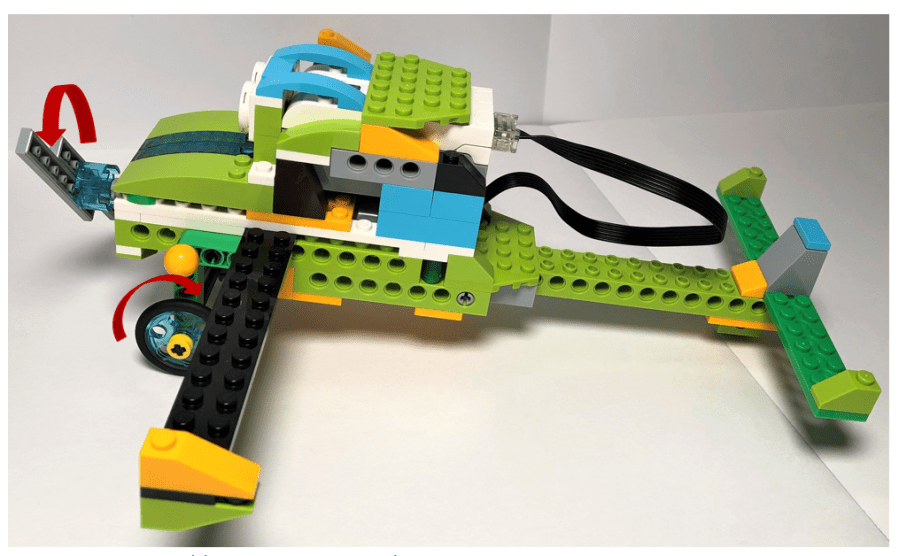
In my previous post, I analyzed an interesting LEGO WeDo 2.0 model - a helicopter model. It uses one motor to drive three moving components - the top propeller, the rear propeller and its two wheels. In this post, I will analyze another helicopter model which uses one motor to drive two components - a …

Continue reading LEGO WeDo 2.0 Model – Another Helicopter Model